|
|
Submarine, Nautical Terms and Glossary |
Have a correction or to
suggest an addition
|
|
|
Check Out Our Main Page
(Click on the picture or the text)
Select the letter to see a list of items
| 1, 2, 3, etc. | ||||||||||||
| A | B | C | D | E | F | G | H | I | J | K | L | M |
| 0'dark hundred | Pronounced "oh dark". Referring to some point really early in the morning. This term is typically used in mockery of Hollywood actors who pronounce military time with an "oh" rather than a "zero"--for example "oh-nine-hundred" as opposed to the correct military time: zero-nine-hundred (usually shortened to "zero-nine"). |
| 2JV | Engineering sound-powered phone circuit. See sound powered phones. |
| Aft | To go towards the rear (stern) of a vessel. Used as a relationship term. |
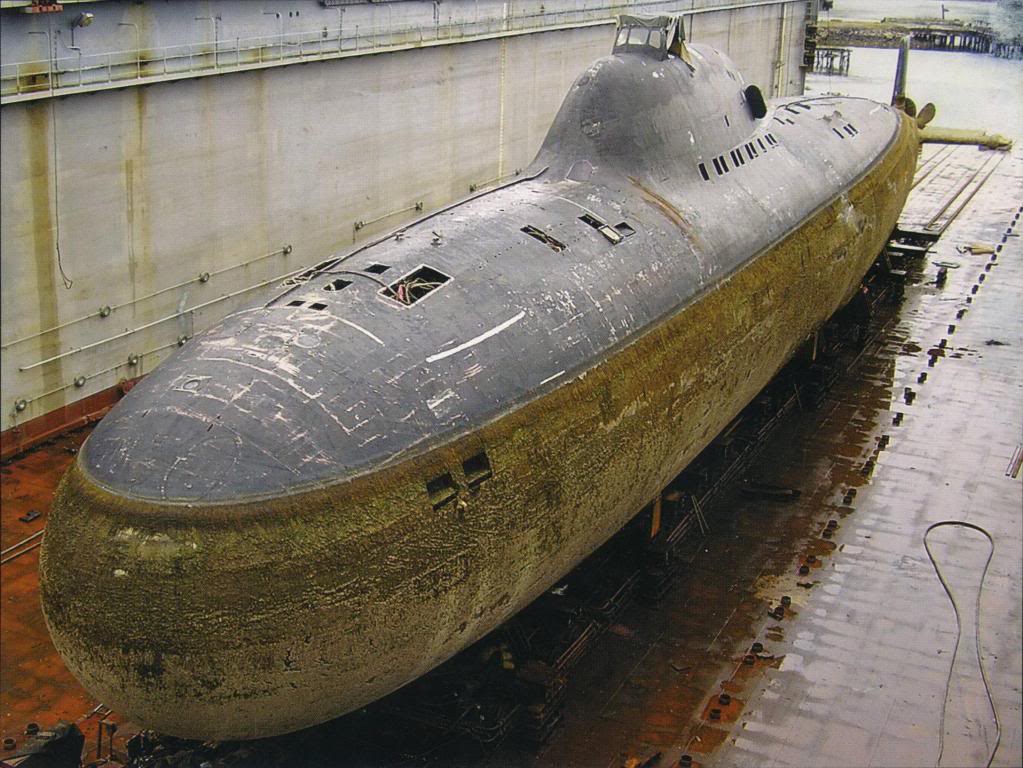
| Alpha | (1) First letter of the phonetic (sound) alphabet.
Used when voicing the letter "A" to avoid confusion. (2) A
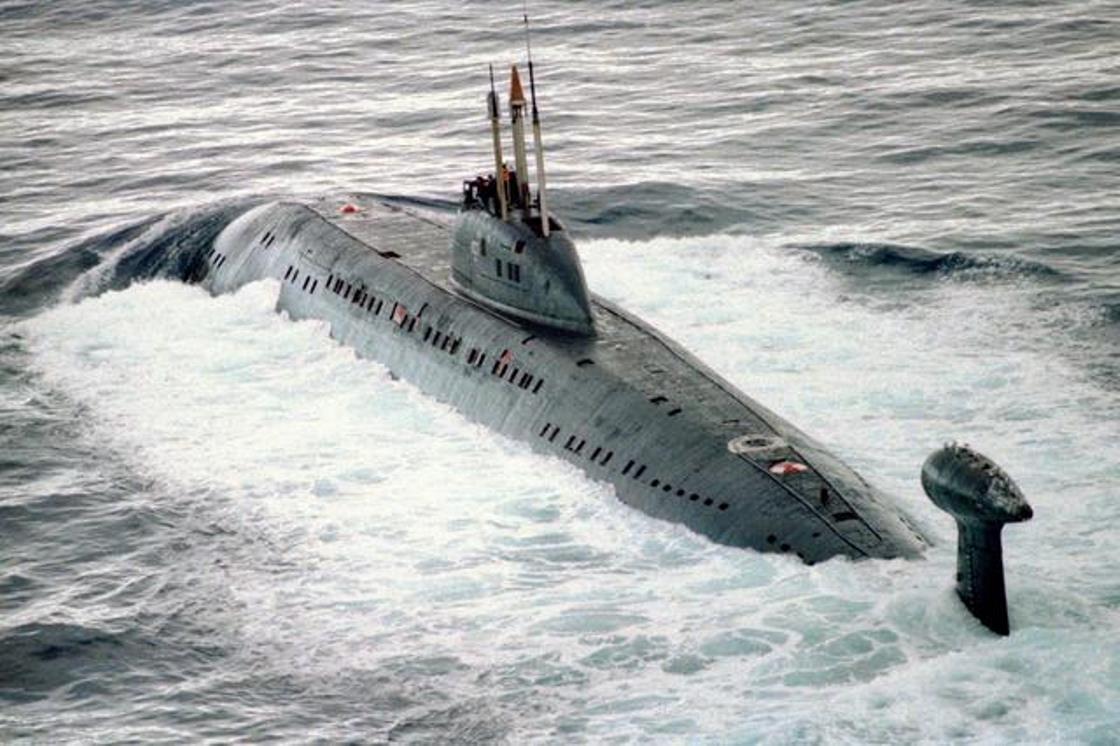
somewhat experimental class of Soviet submarine class of hunter/killer
nuclear powered vessels. They were the fastest and deepest diving class
of military submarines built. They were designed to
meet the demanding requirements - sufficient speed to successfully
pursue any ship; the ability to avoid anti-submarine weapons and to
ensure success in underwater combat; low detectability, in particular to
airborne MAD arrays, and also especially to active sonars; minimal
displacement and minimal crew complement. A special titanium alloy hull
would be used to create a small, low drag, 1,500 ton, six compartment
vessel capable of very high speeds (in excess of 40 knots) and deep
diving. The submarine would operate as an interceptor, staying in harbor
or on patrol route and then racing out to reach an approaching fleet. A
high-power liquid-metal-cooled nuclear plant was devised meaning
extensive automation would also greatly reduce the needed crew numbers
to just 16 highly trained men. The practical problems with the design
quickly became apparent and in 1963 the design team was replaced and a
less radical design was proposed, increasing all main dimensions and the
vessel weight by 800 tons and almost tripling the crew.
(Soviet Alpha-class awaiting decommissioning.) |
| Alpha Particle | In nuclear power, this is the heaviest sub-atomic particle -- and very ionizing -- but easily shielded by as little as a sheet of paper. Failed fuel cladding would be the primary source aboard ship and this would remain in the main coolant. |
| Acoustic | Means "sound" as in acoustic (sound homing) torpedo. |
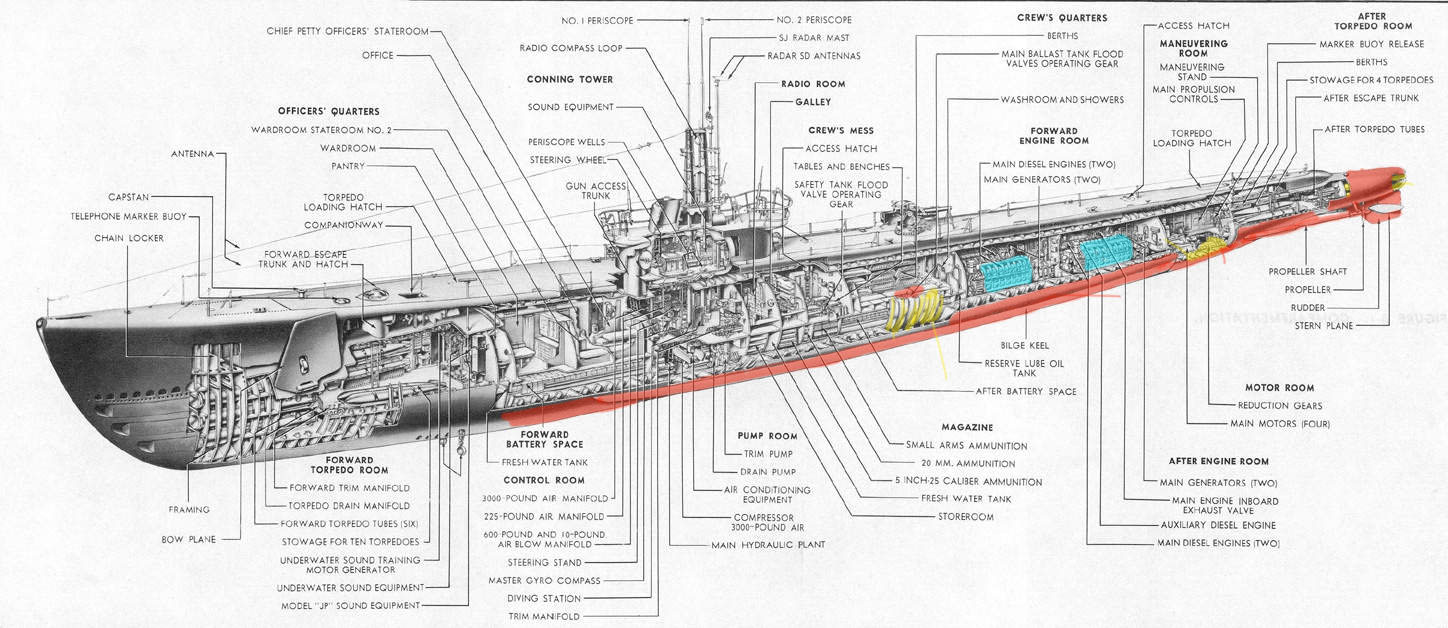
| After Battery Compartment | (Diesel Submarine) Main section of
the submarine behind the control room; houses battery cells and crew
living and dining spaces. (see layout)
|
| Alarms | A submarine's alarm system is
integrated into the 1MC System and consists of four signal generator
modules, each one producing a specific sound.
The Diesel submarines had electric, motor driven, klaxons dispersed throughout the boat. The modern signal is an approximate simulation. The general and collision alarms were generated by electronic modules.
|
| AMR | The Auxiliary Machinery Room. On some boats this space was also referred to as the AMS for Auxiliary Machinery Space. Fast attack submarines had one, FBM submarines had two, referred to as "Forward AMR(S)" and "Aft AMR(S)." |
| Announcing Systems |
1MC — General Announcing - Used only as authorized by the Officer of the Deck. Submarine General Announcing Groups: 1. All - Ship wide 2. Weather Deck Forward (Diesel boats) 3. Weather Deck Aft (Diesel boats) 4. Engine Rooms (Diesel boats) 5. Upper & Main Deck Passages, Mess, Lounges, Galley (Diesel boats) 6. Lower Deck Passageways, Shaft Alley, Steering Gear Room (Diesel boats) 2MC — Engineering Announcing - Propulsion Plant Engineering machinery spaces only 4MC — Damage Control 2-way Emergency Reporting Announcing used with the XJA system. Various sound powered phone handsets throughout the ship have 4MC selectors. When 4MC is selected the sound powered phone user can broadcast on the 4MC. (see Intercom Systems)
|
| Angles and Dangles | (Submarine Service) Placing the boat in crazy angles and positions soon after leaving port, to see whether anything breaks loose. Similar-consequence noises while on patrol are not desired. |
| Angle of Attack | The angle measured between the
relative wind and the chord line of an airfoil. Essentially, the angle
between the air movement (*not* the horizon!) and the aircraft’s wing.
Has a tremendous import in the handling and behavior of the aircraft.
Abbreviated AOA. Aka ‘Alpha’, from the engineering notation for AOA.
Primarily an aviation term, although it is applicable to other fluid
environments such as a ship’s propeller in water.
(Examples of the effect of changing angle of attack.) |
| Astern | Something behind the stern (rear) of a vessel. |
| ASW | Anti-Submarine Warfare. |
| AUX | Pronounced ‘ox.’ Verbal shorthand for 'auxiliary', as when referring to a machinery space, 'Aux One'. |
| Auxiliaryman | A member of the Auxiliary of “A” Gang. Typically they were non-nuclear trained Machinist Mates and Enginemen who maintained all of the non-nuclear mechanical systems on a nuke boat. |
| Aweigh | (sometimes seen -- improperly -- as
"away") When a ship raises (weighs) anchor, the anchor is said to be
aweigh as soon as it is no longer in contact with the sea bottom. From
the process of weighing anchor; the sequence of reports is usually as
follows:
|
| Aye, aye | "Yes (I heard the order, I understand the order, and I intend to obey the order)." |
| Baffles | The cone-shaped area extending directly behind a submarine underway where sonar cannot detect any sounds due to the noise caused by the submarine’s own propeller. |
| Ballast | Large tanks are filled with seawater, which acts as weight, causing the submarine to lose buoyancy and sink. To surface, compressed air is pumped into the tanks, forcing the seawater out and restoring positive buoyancy. |
| Batten Down | Make fast, secure, or shut. Originally, deck hatches did not have hinged, attached covers. Hatch covers were separate pieces which were laid over the hatch opening, then made fast with battens (pieces of timber). |
| BCP | The Ballast Control Panel. The watch station where everything pertaining to the trim of the boat can be monitored and controlled. |
| Beta Particle | An electron of nuclear origin, its source is from the decay of fission products |
| Binnacle List | Many novice sailors, confusing the words 'binnacle' and 'barnacle', have wondered what their illnesses had to do with crusty growths found on the hull of a ship. Their confusion is understandable. Binnacle is defined as the stand or housing for the ship's compass located on the bridge. The term binnacle list, in lieu of sick list, originated years ago when ship corpsmen used to place a list of sick on the binnacle health. After long practice, it came to be called binnacle list. |
| Bitter End | Properly, the free or loose end of a line. Originally, the bitter end of a mooring line was taken to the bitts to secure it. |
| Blowdown | A generic engineering term which can be used as noun or verb. A cleaning and/or venting process. Some specific applications: (1) A process for cleaning water-sides of a boiler. A top blow removes scum and floating contaminants, a bottom blow removes sludge. (2) To backflush and clean a SEACHEST. (3) The process of removing excess pressure from a system, or venting it completely. |
| Bluejacket's Manual | The Bluejacket's Manual is the basic
handbook for United States Navy personnel. First issued in 1902 to teach
new recruits about naval procedures and life and offer a reference for
active sailors, it has become the "bible" for Navy personnel, providing
information about a wide range of Navy topics. The current version is
the Centennial Edition, issued in 2002.
|
| Bow | The most forward part of a ship. |
| Boat | Water craft small enough to be carried on a ship, unless a submarine, which is ALWAYS called a boat. A ship may be called a boat but ONLY by members of its crew, and only those who have actually completed a deployment. |
| Boomer | Nuclear ballistic missile submarine. Primary mission is nuclear deterrence. Also used as a nickname for their crew members. |
| Bow Array | That part of the sub’s sonar suite
which is located in the bow.
(Diagram of the new Virginia-class area showing sonar bow array and mission-selectable missile tubes.) |
| Bridge | On a submarine, the small
observation area on top of the fairwater or sail.
(The bridge of a nuclear submarine.) |
| Bravo | Second letter of the phonetic (sound) alphabet. Used when voicing the letter "B" to avoid confusion. |
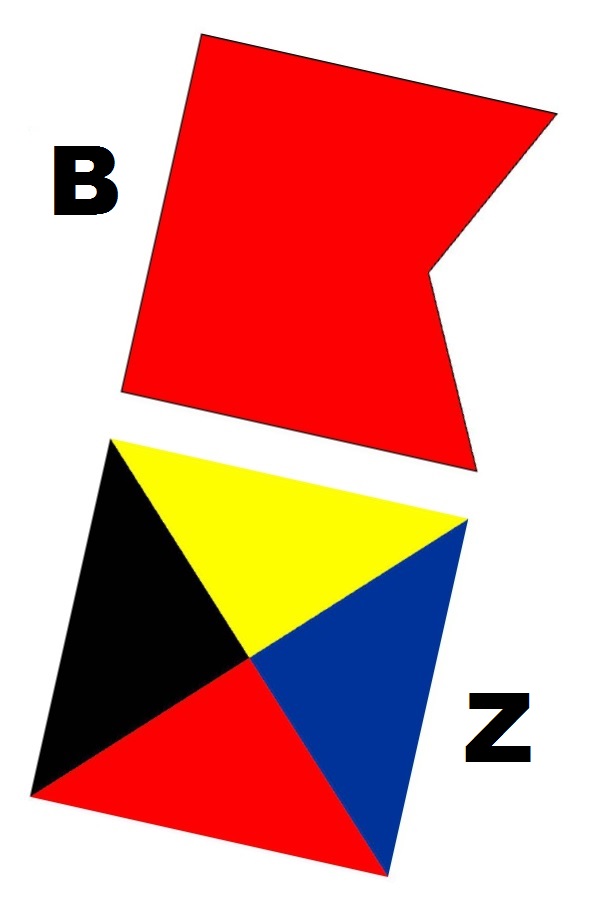
| Bravo Zulu | The term originates from the Allied Signals Book (ATP 1), which in the aggregate is for official use only. Signals are sent as letters and/or numbers, which have meanings by themselves sometimes or in certain combinations. A single table in ATP 1 is called "governing groups," that is, the entire signal that follows the governing group is to be performed according to the "governor." The letter "B" indicates this table, and the second letter (A through Z) gives more specific information. For example, "BA" might mean "You have permission to . . . (do whatever the rest of the flashing light, flag hoist or radio transmission says) "BZ" happens to be the last item in the governing groups table. It means "well done". |
| Brow | The proper term for what is often called the ‘gangway,’ the temporary bridge connecting the ship’s quarterdeck to the pier. |
| Bubble | The up or down angle of a submarine underway, measured in degrees from the horizontal. A “Zero Bubble” is an even keel. |
| Bug Juice | A non-carbonated soft drink similar to Kool-Aid. This quickly becomes the "drink de jour" when fresh beverage supplies (i.e., milk) run out. |
| Bulkhead | A wall or vertical partition. |
| Burner | In a submarine, a system that burns carbon monoxide and hydrogen out of the air, converting H2 to water and CO to CO2. CO2 is then removed by the SCRUBBER. |
| Butt Kit | Ashtray. |
| Captain's Mast | Non-judicial disciplinary procedure, usually meted out by unit commanders. |
| Channel Fever | Anxiety, usually registered while waiting to tie up to the pier after a long deployment. |
| Charlie | Third letter of the phonetic (sound) alphabet. Used when voicing the letter "C" to avoid confusion. |
| Chicken Switches |
Switches in the overhead above the Dive Officer's station that release 4,500 lb air into the main ballast tank, initiating the Emergency Main Ballast Tank blow (EMBT blow) causing the tanks to fill with air and the submarine to rise to the surface in a real hurry. Sometimes, engineering drills may cause the sub to go near test depth (depth the submarine has been tested to) if there is a delay in recovering the reactor (or many other reasons). So if the Dive Officer blows the tanks (actually, whoever has the Con will issue the order) they were afraid of sinking. Hence, Chicken Switches. |
| COB | Only in submarines, this is the Chief of the Boat, the designated senior enlisted man aboard. |
| Conformal Array | A sonar array whose transducers are attached at various locations about the hull, rather than being concentrated on one location. See also BOW ARRAY. |
| Conn |
Originally short for Conning Tower from which the
submarine was controlled, it now refers to the Control Room where this
function is preformed on nuclear submarines. Also used as a verb as in,
"to conn the boat."
(The helm/planes control and the periscope are part of the Control Room) |
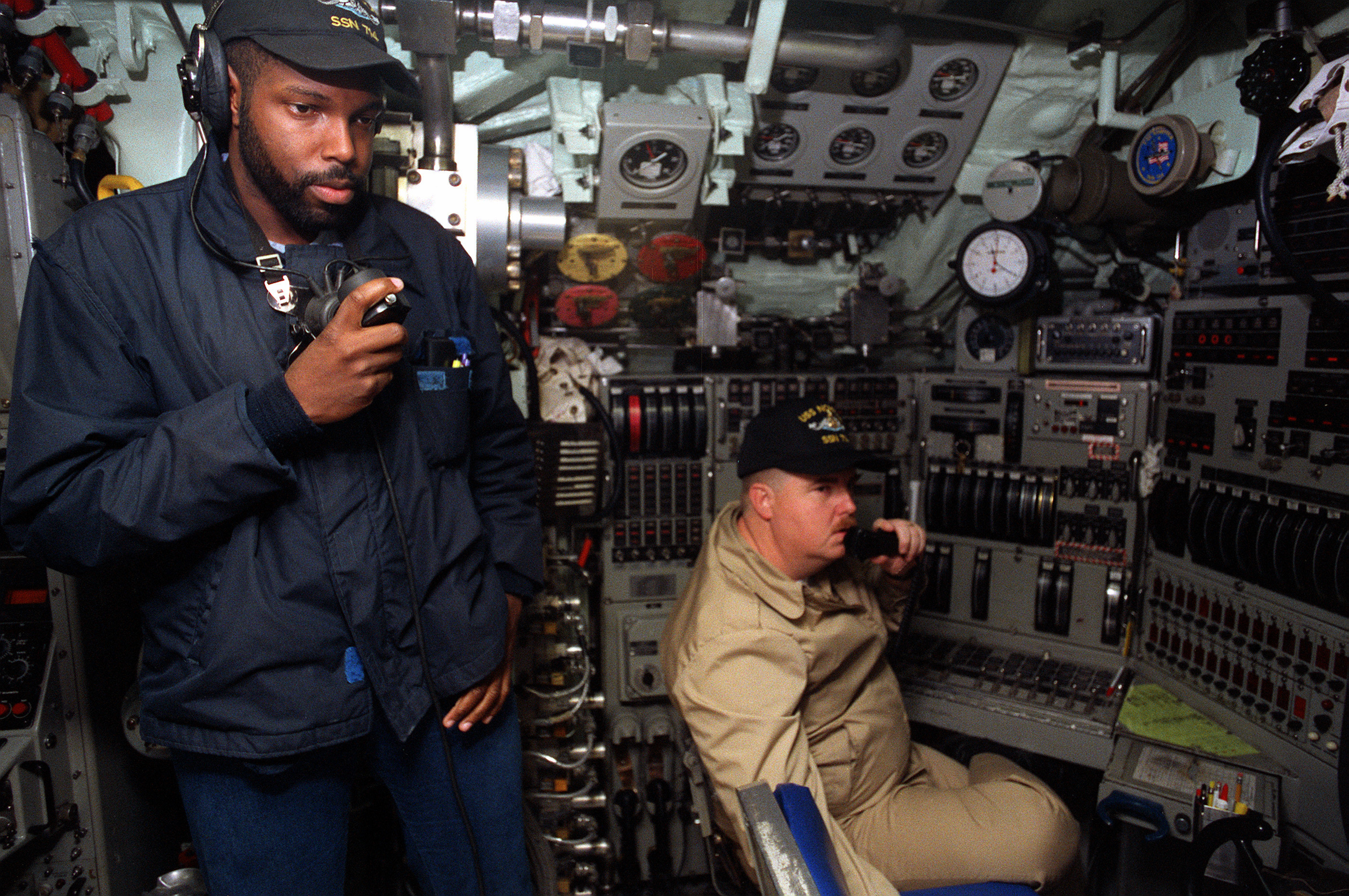
| COW | Chief Of (the) Watch. (submarine only) Responsible for coordinating shipboard evolutions such as housekeeping, watch standing, wake-ups, etc. Also controls the BCP (ballast control panel) while underway. |
| Crazy Ivan | In submarines and demonstrated in the movie The Hunt for Red October. Russian submarines would quickly turn 180 degrees while underway to see whether any American submarines were following. Collisions occasionally resulted during the Cold War. |
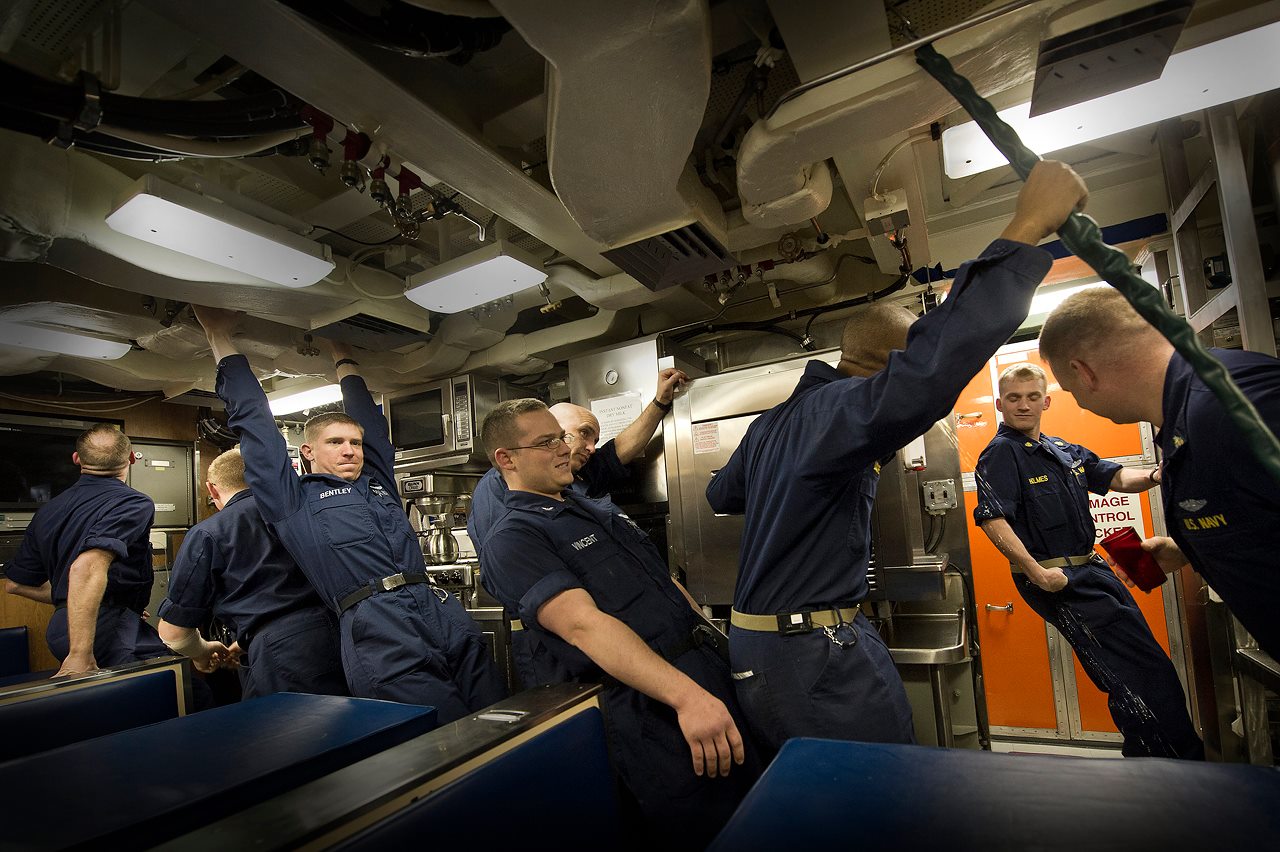
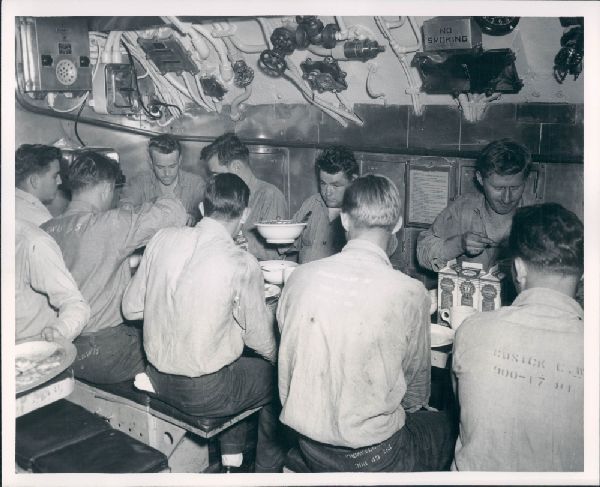
| Crews Mess |
The eating area for a submarine enlisted crew. On a
diesel submarine, this area was the forward part of the After Battery
Compartment. On a nuclear submarine, it's the middle level of the
Operations Compartment.
(Crews Mess on a nuclear sub.) |
| Critical | The condition of a nuclear reactor were a steady-state, self-sustaining nuclear reaction is happening. Power level is neither increasing (super-critical) or decreasing (sub-critical.) |
| Crush Depth | The designed depth at which the pressure hull of a submarine will collapse. |
| Delta | Fourth letter of the phonetic (sound) alphabet. Used when voicing the letter "D" to avoid confusion. |
| Dink | A non-qualified sailor on a submarine who is behind in his qualification process. |
| Ditty bag | Any mesh bag, but so named because usually used to contain soiled laundry. |
| Dive Planes | The equivalent to aircraft elevators on a submarine; movable, horizontal surfaces used to control the dive (pitch) angles. Usually there are two pairs of planes, mounted on bow and stern, or on the fairwater (sail) and stern. |
| Diving trim | The term diving trim designates that condition of a submarine when it is so compensated that completing the flooding of the main ballast, safety, and bow buoyancy tanks will cause the vessel to submerge with neutral buoyancy and zero fore-and-aft trim. |
| Dog | To secure tightly, specifically to "dog a hatch" to prevent water from coming in preclude the spread of fire. |
| Dog watches | The 1600-2000 evening watch is customarily split into two two-hour "dog" watches, so that the watch sections rotate rather than being stuck with the same schedule every day. Also permit everyone to get evening chow at a reasonable hour (although First Dog watch standers usually find the better chow is all gone). |
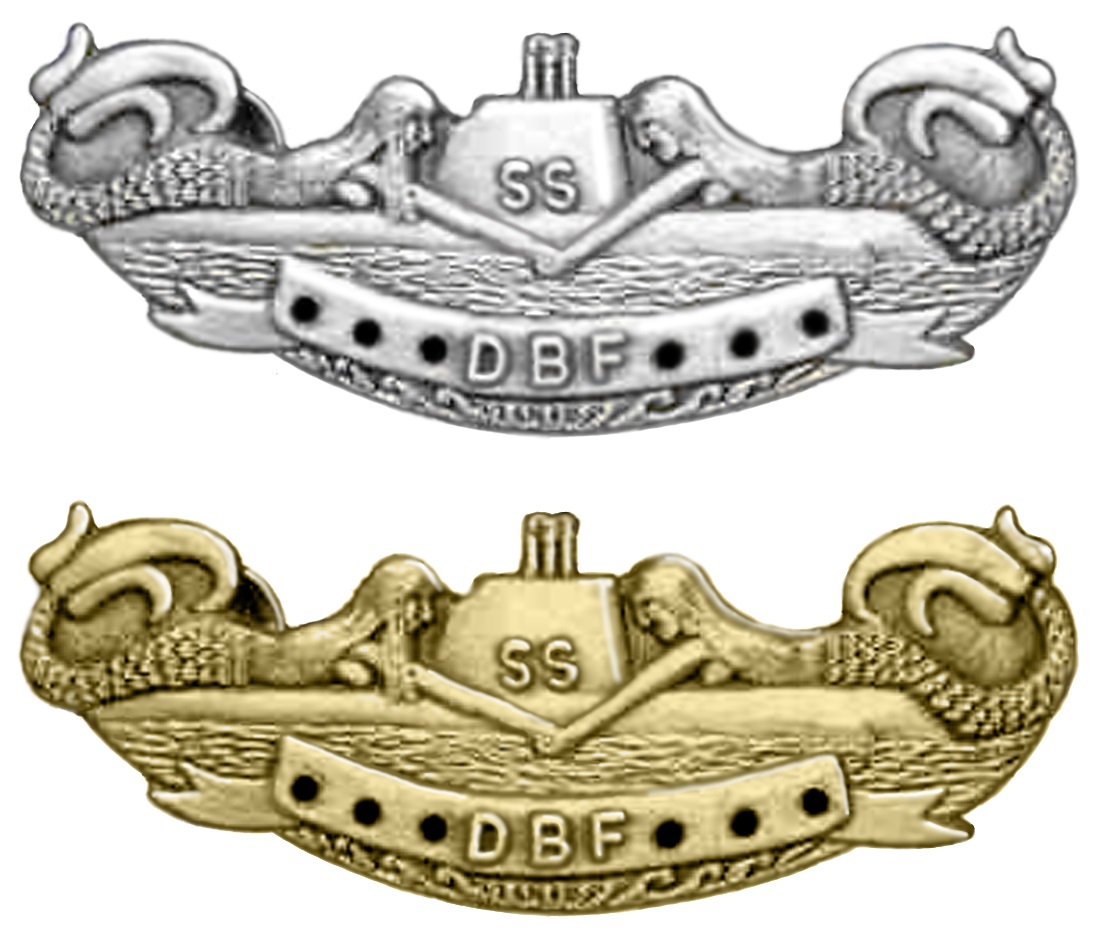
| Dolphins |
Device or insignia indicating "Qualified in
Submarines." Called dolphins because of the dolphin fish used in the
design.
(Officers gold dolphins) (Enlisted silver dolphins) |
| Dungarees | Until very recent times, these were the modern Sailor's work clothes. The term is not modern, however, but dates to the 18th century and comes from the Hindi word dungri, for a type of Indian cotton cloth. |
| Echo | Fifth letter of the phonetic (sound) alphabet. Used when voicing the letter "E" to avoid confusion. |
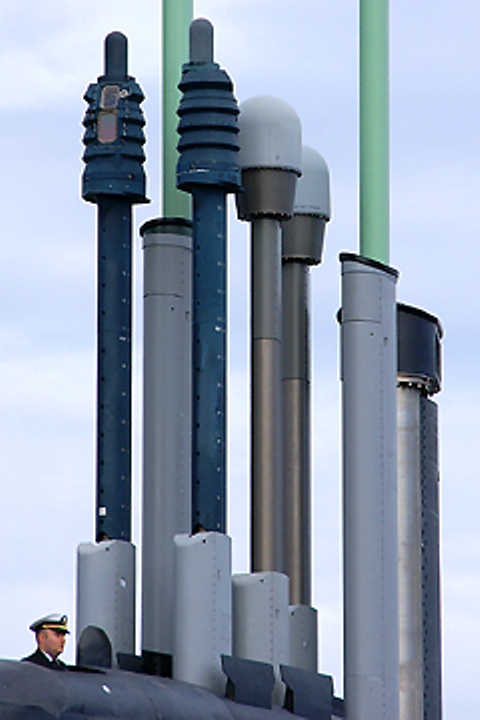
| ECM |
Electronics Countermeasures. Equipment that monitors
an enemy or other forces electronic signals to obtain intelligence or,
in some cases, to jam it. On submarines, this monitoring equipment is
often operated by “Spooks” on clandestine deployments.
(Mast extended on a new Virginia-class
submarine. |
Eight Bells |
Aboard
Navy ships, bells are struck to designate the hours of being on watch.
Each watch is four hours in length. One bell is struck after the first
half-hour has passed, two bells after one hour has passed, three bells
after an hour and a half, four bells after two hours, and so forth up to
eight bells are struck at the completion of the four hours. Completing a
watch with no incidents to report was "Eight bells and all is well." The practice of using bells stems from the days of the sailing ships. Sailors couldn't afford to have their own time pieces and relied on the ship's bells to tell time. The ship's boy kept time by using a half-hour glass. Each time the sand ran out, he would turn the glass over and ring the appropriate number of bells. |
| Emergency Blow |
When a sub rapidly blows all of the ballast out of its tanks, resulting
in a rapid ascent and an impressive display as the sub breaks the
surface.
(USS Oklahoma City SSN-723 conducts an emergency blow) |
| EOOW | Engineer Officer Of the Watch. Pronounced 'ee-ow'. |
| Eternal Patrol | The last and still on-going patrol of a submarine lost at sea. The subs and the sailors are on eternal patrol. |
| Fairwater | The more modern term for the conning tower of a submarine, also called the sail. the Fairwater Planes are diving planes located on a submarine’s fairwater. |
| Fast Attack | Refers to submarines -- designated SSN -- whose primary missions are sea-lane control, anti-shipping operations, anti-submarine warfare, and intelligence operations. |
| FBM | Fleet Ballistic Missile submarine; an earlier term for a Ballistic Missile Submarine, i.e. BOOMER. |
Fathom
|
A fathom is six feet. Fathom was originally a land measuring term derived from the Ango-Saxon word "faetm" meaning to embrace. In those days, most measurements were based on average size of parts of the body, such as the hand (horses are still measured this way) or the foot (that's why 12 inches are so named). A fathom is the average distance from fingertip to fingertip of the outstretched arms of a man — about six feet. Since a man stretches out his arms to embrace his sweetheart, Britain's Parliament declared that distance be called a "fathom" and it be a unit of measure. The word was also used to describe taking the measure or "to fathom" something. Today, of course, when one is trying to figure something out, they are trying to "fathom" it. |
Forecastle
|
The appropriate pronunciation for this word is "fo'ksul". The forecastle is the forward part of the main deck. It derives its name from the days of Viking galleys when wooden castles were built on the forward and after parts the main deck from which archers and other fighting men could shoot arrows and throw spears, rocks, etc. |
| Fouled anchor | The fouled (rope- or chain-entwined)
anchor so prevalent in our Navy's designs and insignia is a symbol at
least 500 years old that has it origins in the British traditions
adopted by our naval service. The fouled
anchor was adopted as the official seal of Lord High Admiral Charles
Lord Howard of Effingham during the late 1500s. A variation of the seal
had been in use by the Lord High Admiral of Scotland about a century
earlier.
(A fouled anchor used in a piece of jewlery.) |
| Foxtrot | (1) Sixth letter of the phonetic (sound) alphabet.
Used when voicing the letter "F" to avoid confusion. (2) A
class of Soviet diesel-electric submarine. The Foxtrot class was
comparable in performance and armament to most contemporary designs.
However, its three screws made it noisier than most Western designs.
(A Soviet Foxtrot submarine at sea.) |
Galley
|
The galley is the kitchen of the ship. The best explanation as to its origin is that it is a corruption of "gallery". Ancient sailors cooked their meals on a brick or stone gallery laid amidships. |
| Gedunk | Candy, or a place that sells candy in a short form of Gedunk bar. Also "ice cream." |
| GDU | Garbage Disposal Unit-- A device
used to send weighted bags of trash overboard while submerged.
(The GDU unit aboard the USS Albuquerque SSN-706) |
| GITMO | Guantanamo Bay Naval Station on
Cuba. A 1934 treaty reaffirming the lease granted Cuba and her trading
partners free access through the bay, modified the lease payment from
$2,000 in U.S. gold coins per year, to the 1934 equivalent value of
$4,085 in U.S. dollars, and made the lease permanent unless both
governments agreed to break it or the U.S. abandoned the base property.
(Location of "GITMO" on Cuba.) |
| Goat Locker | The Chief's quarters. |
| Golf | (1) Seventh letter of the phonetic (sound) alphabet.
Used when voicing the letter "G" to avoid confusion. (2)
Golf-class diesel-electric ballistic submarine. The submarine was
originally designed to carry three R-11 FM ballistic missiles with a
range of around 150 km. These were carried in three silos fitted in the
rear of the large sail behind the bridge. They could only be fired on
the surface but the submarine could be underway at the time. Only the
first three boats were equipped with these—the remaining ones were
equipped with the longer range R-13 missiles.
(A Soviet Golf-class submarine.) |
| Hanging Garden | Berths suspended from the overhead in a torpedo room in diesel-electric and older nuke subs. |
| Hatch | A vertical opening in a deck sometimes (but incorrectly) also used for any door. |
| Head | The ubiquitous Navy term for all restrooms. It takes its name from the location on sailing ships that sailors would go to relieve themselves (ropes hanging from the bow to the bowsprit over the FIGUREHEAD of the ship.) |
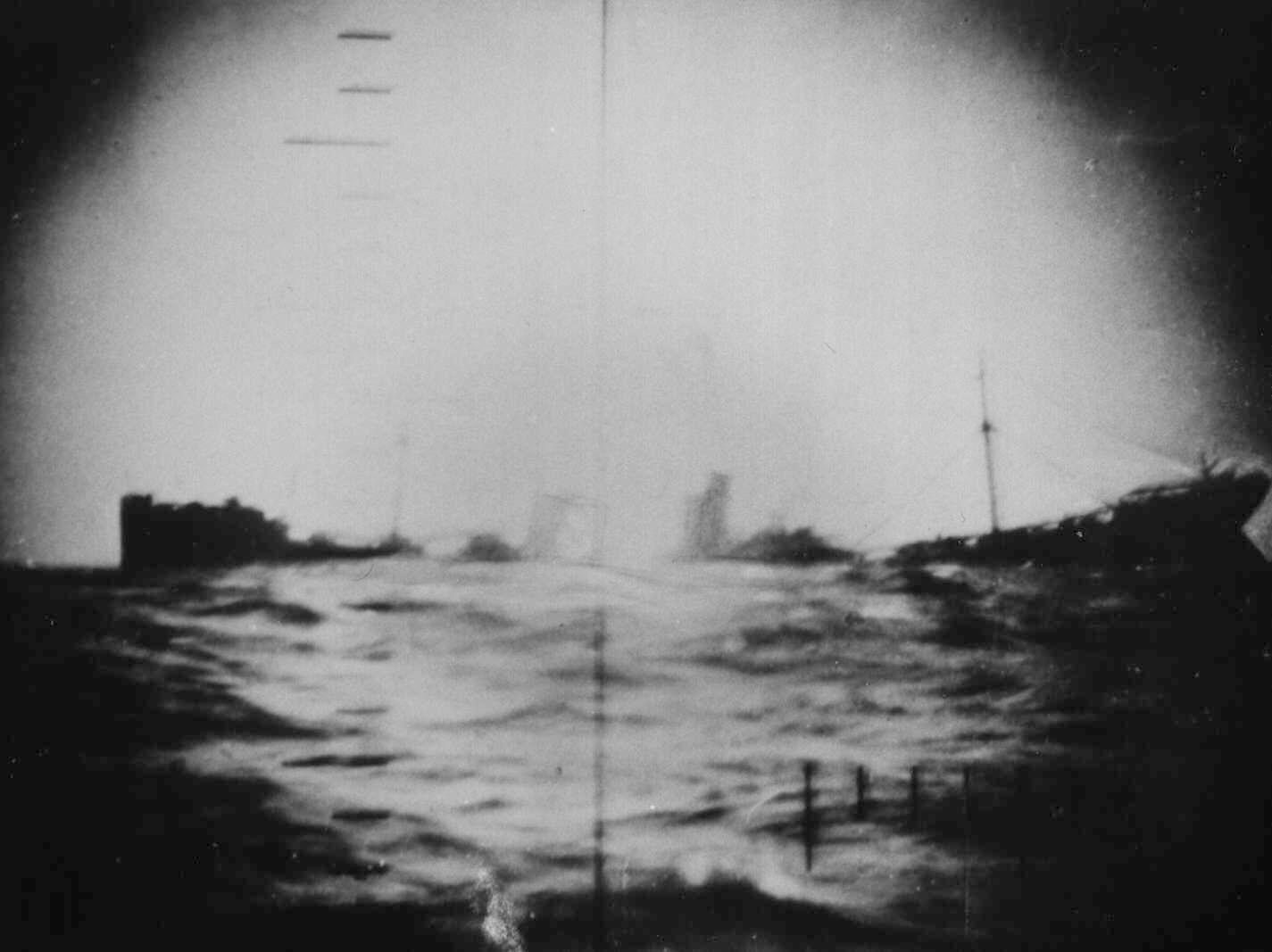
| Hot, Straight, and Normal | A report from the sonar operator that torpedoes just fired are running hot (proper ignition of the engine has occurred), straight (not malfunctioning and steering in a circular run), and normal (no unusual noise are being emitted). Originally used to report performance of steam torpedoes, ca. WWII. |
| Hotel | (1) Eighth letter of the phonetic (sound) alphabet.
Used when voicing the letter "H" to avoid confusion. (2) A
class of Soviet nuclear submarine designed to carry the D-2 launch
system and R-13 missiles. The Hotel design was based on the Project 627
November class, the first Soviet nuclear submarines, modified by adding
the missile compartment from the Golf class submarines. Additionally,
the Hotels had small horizontal hydroplanes for better maneuverability,
and more reliable electro-hydraulic command control surfaces for
high-speed underwater operations with reduced noise. The D-2 launch system on the Hotels placed three R-13 missiles in vertical containers directly behind the sail. The submarine had to be surfaced to launch, but all three missiles could be fired within 12 minutes of surfacing. The infamous K-19 was a Hotel-class.
(This is the infamous K-19, a Hotel-class Soviet submarine) |
| Hotel Services | Power, water, and steam used for cooking, heating, laundry, or other non-engineering or non-propulsion purposes. |
| India | (1) Ninth letter of the phonetic (sound) alphabet.
Used when voicing the letter "I" to avoid confusion. (2) A
two-ship class of Soviet submarines, the India class of boats were
designed for high surface speeds, and had tracks on their hulls so they
could operate on the ocean floor. The submarines of this class were
designed to function as a base for two Poseidon DSRV's (Deep Submergence
Rescue Vehicles), which could rescue the crew of sunken submarines.
While the India class boats have been seen going to the aid of Russian
Submarines involved in accidents, they have also been observed working
in support of Russian Spetsnaz special operations. The boats had
decompression chambers and medical facilities on board. Two vessels of
this class were built for the Soviet navy. Both were scrapped in the
1990s.
(An artist conception of the use of India-class submarines.) |
| Intercom Systems |
7MC — General Announcing 2-way - Ship Control or Maneuvering Announcing 21MC — Captain's Command 2-way - Bridge, Conn & other stations 22MC — Radio Room / Electronic Control 2-way 27MC — Sonar Control 2-way - Sonar Supervisor 31MC — Escape Hatch Announcing 2-way 47 MC — Weapons - Fire Control & Torpedo Room On Diesel boats: The general announcing system is comprised of two voice communications circuits, one-way (1MC) and two-way (7MC). The same amplifier equipment is used for both circuits. Generally, one channel is used for the 1MC and one for the 7MC, but in an emergency both circuits may be operated through either of the two individual amplifier channels. (see Announcing Systems)
|
| Irish Pennant | Loose thread on uniform. |
| Jacking Gear | The machinery used to jack a shaft. May also be used to lock the shaft. |
| Juliet | Tenth letter of the phonetic (sound) alphabet. Used when voicing the letter "J" to avoid confusion. |
| Kilo | (1) Eleventh letter of the phonetic (sound) alphabet.
Used when voicing the letter "K" to avoid confusion. (2) Also,
a class of Soviet diesel-electric submarine. The boats are mainly
intended for anti-shipping and anti-submarine operations in relatively
shallow waters. Anechoic tiles were fitted on casings and fins to absorb
the sonar sound waves of active sonar, which results in a reduction and
distortion of the return signal. These tiles also help attenuate sounds
that are emitted from the submarine, thus reducing the range by which
the sub may be detected by passive sonar.
(A Kilo-class submarine -- this one operated by the Iranian Navy -- cruises on the surface.) |
| Ladder | Stairs aboard ship. Found in a "ladder well" (stairwell). |
| Lifer | A name given to both officers and enlisted men who love the navy and make it clear they want to be in for 20 or more years. Lifers will try to convince others to re-enlist. Also lifers say things like "there is nothing a sailor needs that is not in his sea-bag" this usually is a comment implying a sailor does not need to see his spouse or children. |
| Lima | Twelfth letter of the phonetic (sound) alphabet. Used when voicing the letter "L" to avoid confusion. |
| Lucky Bag | The lucky bag is defined as a where loose items from a ship are stored until being returned to the owner. According to the 1940 edition of the Blue Jackets' Manual (a handbook for U.S. Navy enlisted personnel), "The lucky bag is a place where the police petty officers stow for safe-keeping effects that are found adrift about the ship. All clothes, etc., found about the decks are placed in the lucky bag. When clothes are piped down, the police petty officer attends and takes care of all clothes not called for and places these in the lucky bag. All effects in this bag belong to the person who lost them. At frequent intervals the lucky bag is opened and the effects distributed to the owners. Where persons have been guilty of carelessness in leaving their effects adrift, they are placed on the report." |
| Main ballast tanks | Tanks that are provided primarily to furnish buoyancy when the vessel is in surface condition and that are habitually carried completely filled when the vessel is submerged. |
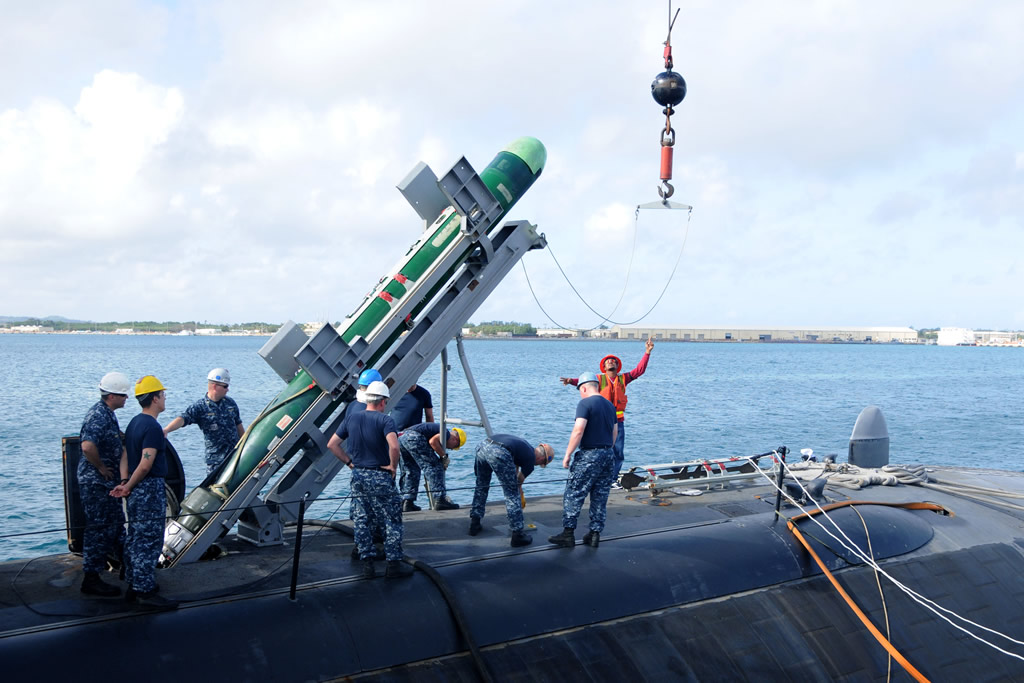
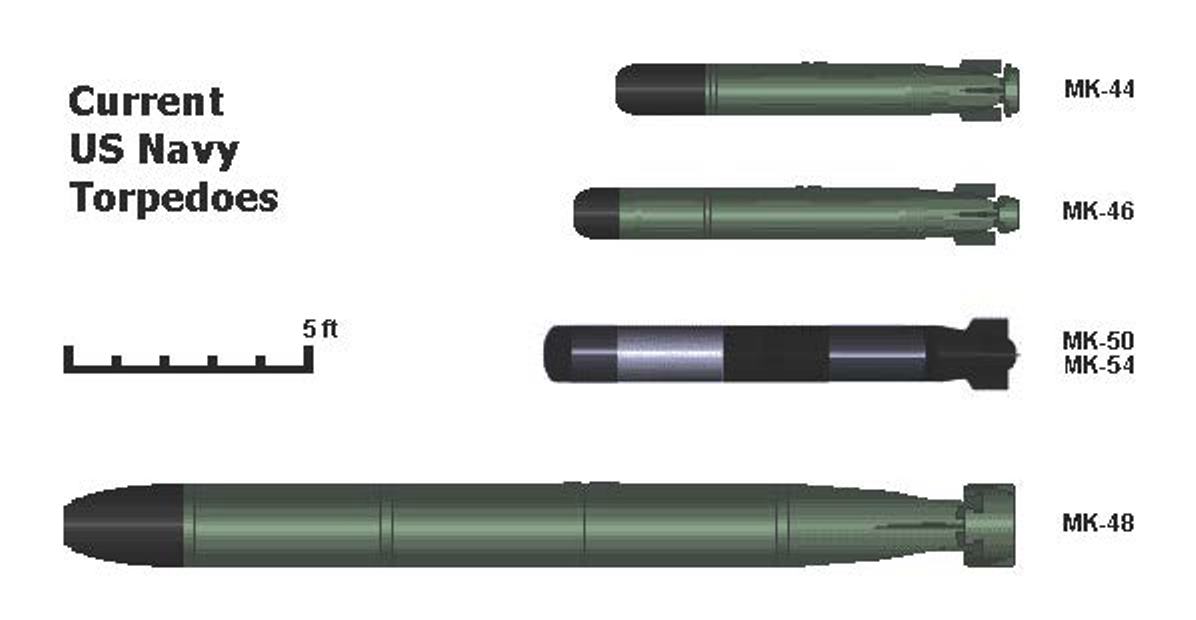
| Mark-48 | The Mark 48 and its improved ADCAP
(Advanced Capability) variant are heavyweight submarine-launched
torpedoes. They were designed to sink fast, deep-diving nuclear-powered
submarines and high-performance surface ships. This is the primary U.S. submarine torpedo
in use today. Mk-48 and Mk-48 ADCAP torpedoes can be guided from a
submarine by wires attached to the torpedo. They can also use their own
active or passive sensors to execute programmed target searches,
acquisition and attack procedures. The torpedoes are designed to
detonate under the keel of a surface ship, breaking the ship's back and
destroying its structural integrity. In the event of a miss, it can
circle back for another attempt.
(A Mark 48 torpedo being loaded on a fast attack nuclear submarine.) |
| Mast | Preceded by Captain's or Admiral's, but these are generally not spoken. A form of non-judicial punishment in which a sailor finds himself standing tall in front of the old man when he really screws the pooch. Green felt is usually abundant. |
| Mid Rats: | (Midnight Rations) Meal served around midnight for those crewmembers going on or off watch. |
| Mike | Thirteenth letter of the phonetic (sound) alphabet. Used when voicing the letter "M" to avoid confusion. |
| Main Coolant | Part of the nuclear propulsion system, this system circulates nearly-pure water through the reactor where it picks up heat and transfers it to the secondary, or steam system, were the energy is used to turn turbines and, ultimately, the ships propeller. This coolant system is pressurized to prevent boiling. See PWR. |
| Mooring Line | Lines used to tie the ship to the pier or to another ship. Mooring lines are numbered from forward aft; the direction they tend (lead) is also sometimes given. ‘Number one mooring line’ typically is made fast at the bow, and tends straight across to the pier or other ship. Spring lines tend forward or aft of their attachment point. |
| Mustang | (USN) An officer who has 'come up through the ranks', i.e. started out as an enlisted man and earned a commission. |
| Negative tank | The Negative Tank is a variable ballast tank providing negative buoyancy and initial down-angle. Submarines normally will operate submerged in neutral buoyancy and without trim when the negative tank is nearly empty. It is used to reduce the time required in submerging from surface condition, to reduce the time required to increase depth while operating submerged, and to prevent broaching when decreasing depth. It may be blown or pumped. |
| November | Fourteenth letter of the phonetic (sound) alphabet. Used when voicing the letter "N" to avoid confusion. |
| Nose-coner | A somewhat derogatory title, used by nuclear trained submarine personnel, for all non-nuclear or "forward of the reactor compartment" (the nose cone of the submarine) working crew. |
| Nuke | (1) A ship propelled by nuclear power (2) A person who has been specially trained and qualified as a nuclear operator in the ship's engineering department. Also the opposite of a "nose-coner." |
| Nuke Striker | Pejorative term used by nukes to describe a nose-coner that asks endless questions about the operations of the nuclear power plant. Strikers are sailors that enlist without a guaranteed rate (job), with the intention of floating around until they find a department where they fit in. However, you can't strike for Nuclear Field. |
| Oscar | (1) Fifteenth letter of the phonetic (sound) alphabet.
Used when voicing the letter "O" to avoid confusion.
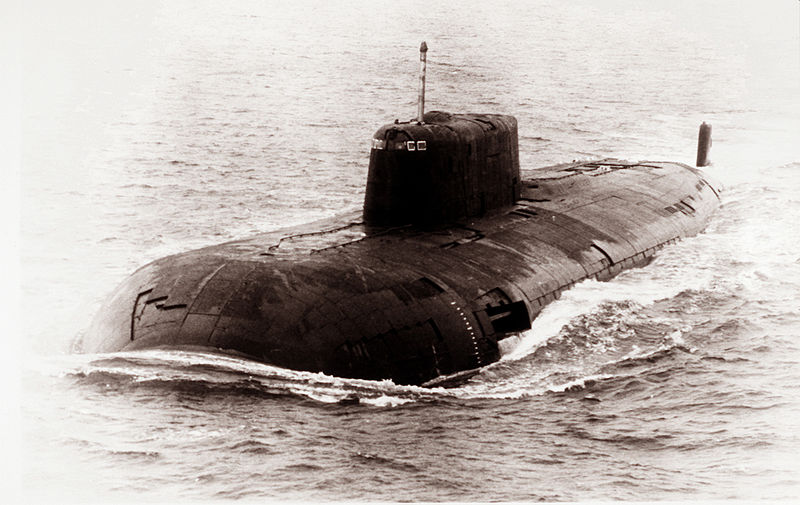
(2) Oscar-class were Soviet nuclear-powered cruise missile submarines.
They were the largest cruise missile submarines in service until the new
(rebuilt) Ohio class SSGN cruise missile submarine on October 15, 2007,
and the third largest submarines as submarines in terms of displacement
and length. Only the Typhoon class Soviet/Russian submarines and the
American Ohio class submarines are larger.
(Oscar-class submarine underway.) |
| Ohio-Class | The Ohio class is a class of
nuclear-powered submarines used by the United States Navy. The United
States has 18 Ohio class submarines: 14 are nuclear-powered SSBNs
(ballistic missile submarines), each armed with 24 Trident II SLBMs;
they are also known as "Trident" submarines, and provide the sea-based
leg of the nuclear triad of the United States strategic nuclear weapons
arsenal. Four are nuclear-powered SSGNs (cruise missile submarines),
each capable of carrying 154 Tomahawk cruise missiles with conventional
warheads.
(Ballistic missile version.) (SSGN fires Tomahawk.) |
| Overhead | What a civilian would call the ceiling. Essentially, the underside of the deck above. |
| Papa | Sixteenth letter of the phonetic (sound) alphabet. Used when voicing the letter "P" to avoid confusion. |
| Passageway | A hallway aboard ship. |
Pea Coat |
Sailors who have to endure pea-soup weather often don
their pea coats but the coat's name isn't derived from the weather. The
heavy topcoat worn in cold, miserable weather by seafaring men was once
tailored from pilot cloth — a heavy, course, stout kind of twilled blue
cloth with the nap on one side. The cloth was sometimes called P-cloth
for the initial letter of "pilot" and the garment made from it was
called a p-jacket — later, a pea coat. The term has been used since 1723
to denote coats made from that cloth.
|
| Ping | (1) To transmit on active sonar, or the sound or signal made by same. (2) (RM) To recognize someone or something. (3) To bounce or wander around aimlessly. |
| Plank Owner | A member of the original commissioning crew of a ship. Traditionally, when a plank owner leaves, he is presented with a piece of the wooden decking. Since the advent of all-metal warships, however, a common plank owner memento is a plaque bearing a brass or bronze escutcheon constructed from the machining scraps of the propellers. |
| Plimsoll Mark | A mark on the side of a ship’s hull
which indicates a certain level of loading and, therefore, draft.
(Plimsoll marks on a ship's hull.) |
| Poopie Suit | Blue coveralls worn by sub crews (and, recently, surface ships) underway. |
| Port | The left side. (see Starboard) |
| Pressure Hull | The watertight, pressure-bearing structure that makes up the living and working area of a submarine. |
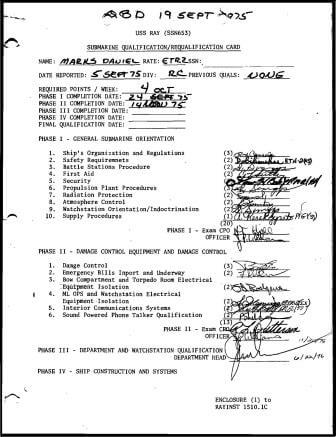
| PQS | Personnel Qualification System. A method of formalizing and tracking the qualification progress of personnel toward watchstation certification. Often abbreviated as 'Qual System'. Used by all warfare specialties, but has reached its ultimate in the submarine service. |
| PWR | Pressurized Water Reactor. A type of
nuclear plant used on all U.S. Navy ships that uses pure water as a moderator/coolant and enriched
uranium as the fuel. All U.S. nuclear submarines have one reactor and
aircraft carriers have two (with the exception of the U.S.S. Enterprise,
which has eight, older style ones.) Modern reactors are designed to last
the life of the ship without a nuclear re-fueling.
(Typical functional diagram of a PWR.) |
| Qual Card | A listing of necessary PQS qualification points. Each completed goal is acknowledged by the signature of the appropriate duty Chief or other authorized signer. May be a single piece of paper or a bound book. |
| Quebec | Seventeenth letter of the phonetic (sound) alphabet. Pronounced "Kay-bec" and used when voicing the letter "Q" to avoid confusion. |
| Rag-hat | Junior sailor, E-6 (First Class Petty Officer) and below. Refers to the sailor’s white hat. |
| Rigged for dive | A submarine is rigged for dive by so compensating the vessel and preparing the hull openings and machinery that the vessel can be quickly and safely submerged and controlled by flooding the main ballast tanks, using the diving planes, and, on diesel powered boats, operating on battery-powered main motors. |
| Romeo | (1) Eighteenth letter of the phonetic (sound) alphabet.
Used when voicing the letter "R" to avoid confusion. (2) Romeo
is a class of Soviet diesel-electric submarine, built in 1950s. The
origin of the Romeo class can be traced to the World War II German Type
XXI Elektroboot U-boat. At the end of World War II, the Soviets obtained
several Type XXIs, from which they were able to obtain certain key
technologies. These technologies assisted in the design of the Zulu- and
Whiskey-class. Further improvements on the design led to the Romeo
class. Only 20 of the Soviet Union's originally intended 560 were
completed between October 1957 and the end of December 1961 because of
the introduction of the nuclear submarine into the Soviet Navy. By
today's standards, the Romeo class submarine is considered obsolete, but
still has some value as training and surveillance vessels.
|
| Sail | The portion of a submarine above the round hull. Often, and mistakenly, called the conning tower from the old diesel-boat days when this structure did indeed hold a compartment called the "conning tower. The sail houses retractable masts and provides roll stability and a ships bridge above the water when surfaced. |
| Sail Planes | Wing-like fins off the side of the sail. Used, with stern planes, for depth control and change. The latest submarines have these replaced with planes mounted on the hull at the bow. |
| Safety tank | The Safety Tank is a heavily reinforced main ballast tank arranged to permit pumping as well as quick blowing to regain positive buoyancy. Under normal submerged conditions, the blowing or pumping of this tank will bring the conning tower above the surface. |
| Scram | Emergency shutdown of a nuclear reactor. The origin of the term has various possibilities but they all date from the dawn of nuclear power. |
Scuttlebutt
|
A scuttlebutt is a drinking fountain. The origin of the word "scuttlebutt," which is nautical parlance for a rumor, comes from a combination of "scuttle" — to make a hole in the ship's hull and thereby causing her to sink —- and "butt" — a cask or hogshead used in the days of wooden ships to hold drinking water. The cask from which the ship's crew took their drinking water — like a water fountain — was the "scuttlebutt". But, since the crew used to congregate around the "scuttlebutt", that is where the rumors about the ship or voyage would begin. Thus, then and now, rumors are talk from the "scuttlebutt" or just "scuttlebutt". |
| Scrubber | (USN Submarines) On a submarine, removes or "scrubs" CO2 out of the air. |
| Shaft Alley | Engineering space aft of engine rooms, where propeller shafts pierce the hull. Location of shaft seals, etc. |
| Shift Colors | When a ship moors, the national colors are broken on the stern, the Jack is broken on the bow, and the national colors ("steaming colors") are hauled down at the masthead, all at the instant the first line goes over. When the ship gets underway, as soon as the last line is cast off the dock, the Jack and colors are struck at bow and stern while the steaming colors are broken at the masthead. |
| Shipshape | Also seen as "Shipshape and Bristol fashion." The desired condition of any ship or unit; the maintenance of seamanlike appearance. Every piece of gear stowed neatly, "a place for everything, and everything in its place." |
| Sierra | Nineteenth letter of the phonetic (sound) alphabet. Used when voicing the letter "S" to avoid confusion. |
| Skimmers | Any sailor who serves on a surface ship (i.e., non-submariner.) Comes from the fact that these sailors only "skim" the surface of the ocean rather than use all of it. |
| Smoking lamp |
The exact date and origin of the smoking lamp has
been lost. However, it probably came into use during the 16th Century
when seamen began smoking on board vessels. The smoking lamp was a
safety measure. It was devised mainly to keep the fire hazard away from
highly combustible woodwork and gunpowder. Most navies established
regulations restricting smoking to certain areas. Usually, the lamp was
located in the forecastle or the area directly surrounding the galley
indicting that smoking was permitted in this area. Even after the
invention of matches in the 1830s, the lamp was an item of convenience
to the smoker. When particularly hazardous operations or work required
that smoking be curtailed, the unlighted lamp relayed the message. "The
smoking lamp is lighted" or "the smoking lamp is out' were the
expressions indicating that smoking was permitted or forbidden. The smoking lamp has survived only as a figure of speech. When the officer of the deck says "the smoking lamp is out" before drills, refueling or taking ammunition, that is the Navy's way of saying "cease smoking." |
| SONAR |
An acronym for SOund Navigation
And Ranging, and is the eyes and ears of a
submarine. Somewhat similar to radar but uses sound waves rather than
electromagnetic radiation. Submarines rarely use active sonar (pinging)
since this will give a way a ships position.
(The sonar room or "shack" aboard a nuclear submarine.) |
| SOSUS | SOund SUrveillance System. A land-based system of seabed hydrophones and sophisticated analysis equipment, used to monitor worldwide movements of ships and submarines. |
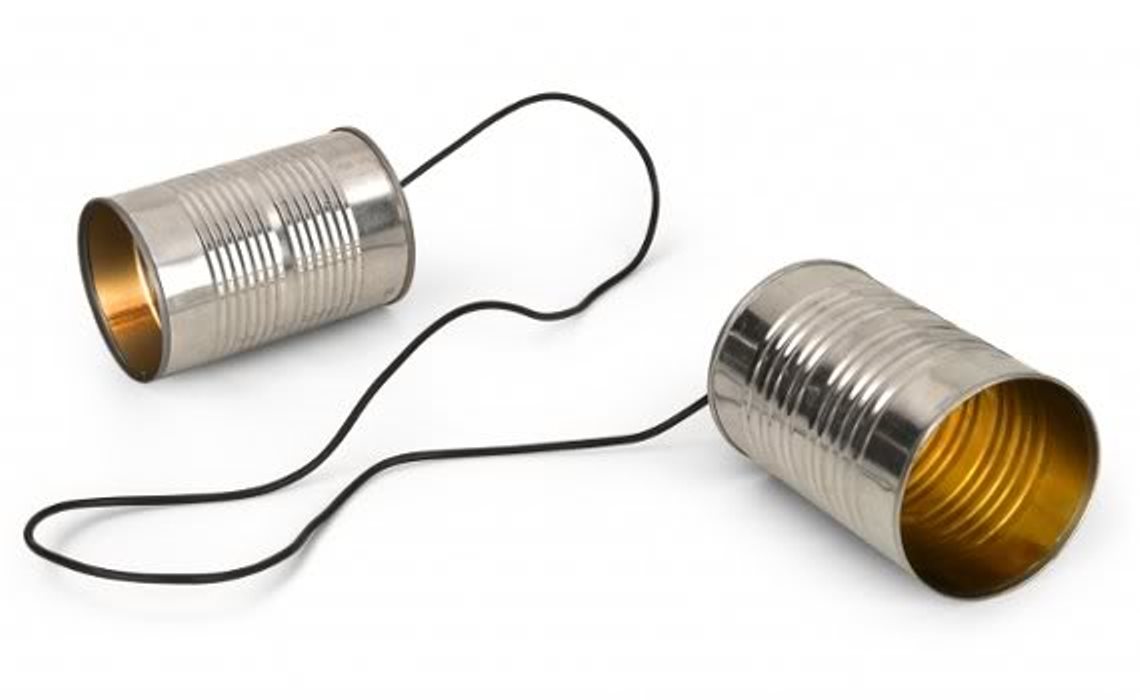
| Sound Powered Phones | A sound-powered telephone is a communication device that allows users to talk to each other with the use of a handset, similar to a conventional telephone, but without the use of external power. This technology has been used for at least six decades for both routine and emergency communication on ships to allow communication between key locations on a vessel even if power, including batteries, is no longer available. A sound-powered phone circuit can have two or more stations on the same circuit. The circuit is always live, thus a user simply begins speaking rather than dialing another station. Sound-powered telephones are not normally connected to a telephone exchange. The system is divided into two circuits, the XJA (handset) used for routine ship's service communication, and the JA (headset) circuits used on all battle control and other functional stations and uses. |
| Spooks | "Sailors" who were specialist in electronic intelligence. They were not part of the regular ships company and would report on board just before the submarine would leave on patrol. |
Starboard |
The Vikings called the side of their ship its board, and they placed the steering oar, the "star" on the right side of the ship, thus that side became known as the "star board." It's been that way ever since. And, because the oar was in the right side, the ship was tied to the dock at the left side. This was known as the loading side or "larboard". Later, it was decided that "larboard" and "starboard" were too similar, especially when trying to be heard over the roar of a heavy sea, so the phrase became the "side at which you tied up to in port" or the "port" side. |
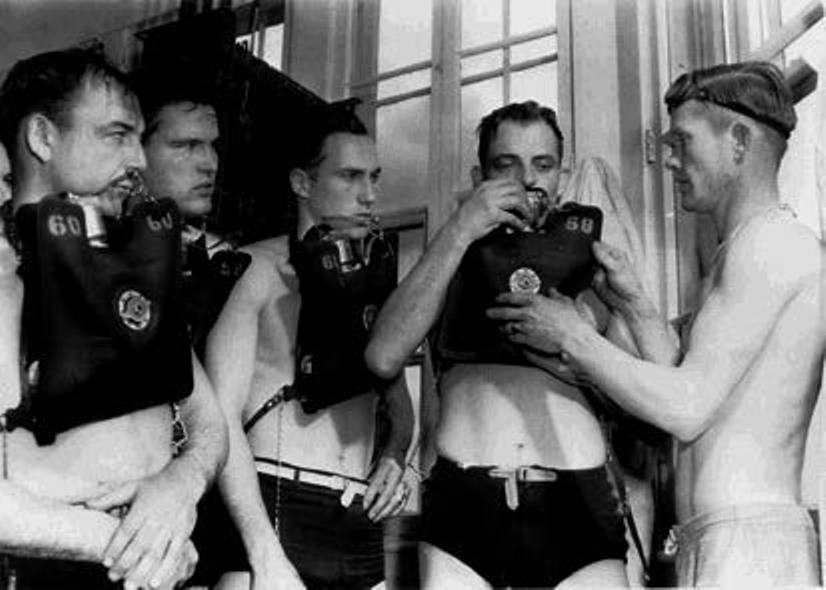
| Steinke Hood |
A Steinke hood is a device designed to aid escape
from a sunken submarine, essentially an inflatable life jacket with a
hood that completely encloses the wearer's head, trapping a bubble of
breathing air. An advancement over its predecessor, the Momsen lung, it
was standard equipment in all submarines of the United States Navy
throughout the Cold War period. The U.S. Navy has replaced Steinke hoods
on U.S. submarines with escape suits called Submarine Escape Immersion
Equipment.
(The standard Steinke Hood.) |
| Tango | Twentieth letter of the phonetic (sound) alphabet. Used when voicing the letter "T" to avoid confusion. |
| Target | In submarine parlance, this is any this is any surface vessel that floats around in two dimensions. |
| Tomahawk |
The Tomahawk® Land Attack Missile (TLAM) is an all-weather, long range, subsonic cruise missile used for land attack warfare, launched from U. S. Navy surface ships and U.S. Navy submarines from either vertical launch tubes or conventional torpedo tubes. Tomahawk carries a nuclear or conventional payload. The conventional, land-attack, unitary variant carries a 1,000-pound-class warhead (TLAM-C) while the submunitions dispenser variant carries 166 combined-effects bomblets (TLAM-D). These cruise missiles are designed to fly at extremely low altitudes at high subsonic speeds, and are piloted over an evasive route by several mission tailored guidance systems.
|
| Torpedo | The primary weapon of submarines,
these are self-propelled devices that are launched from torpedo tubes --
located amidship lower level on fast attacks and in the bow on FBMs.
Various methods of propulsion and guidance are used. See
Mark 48.
|
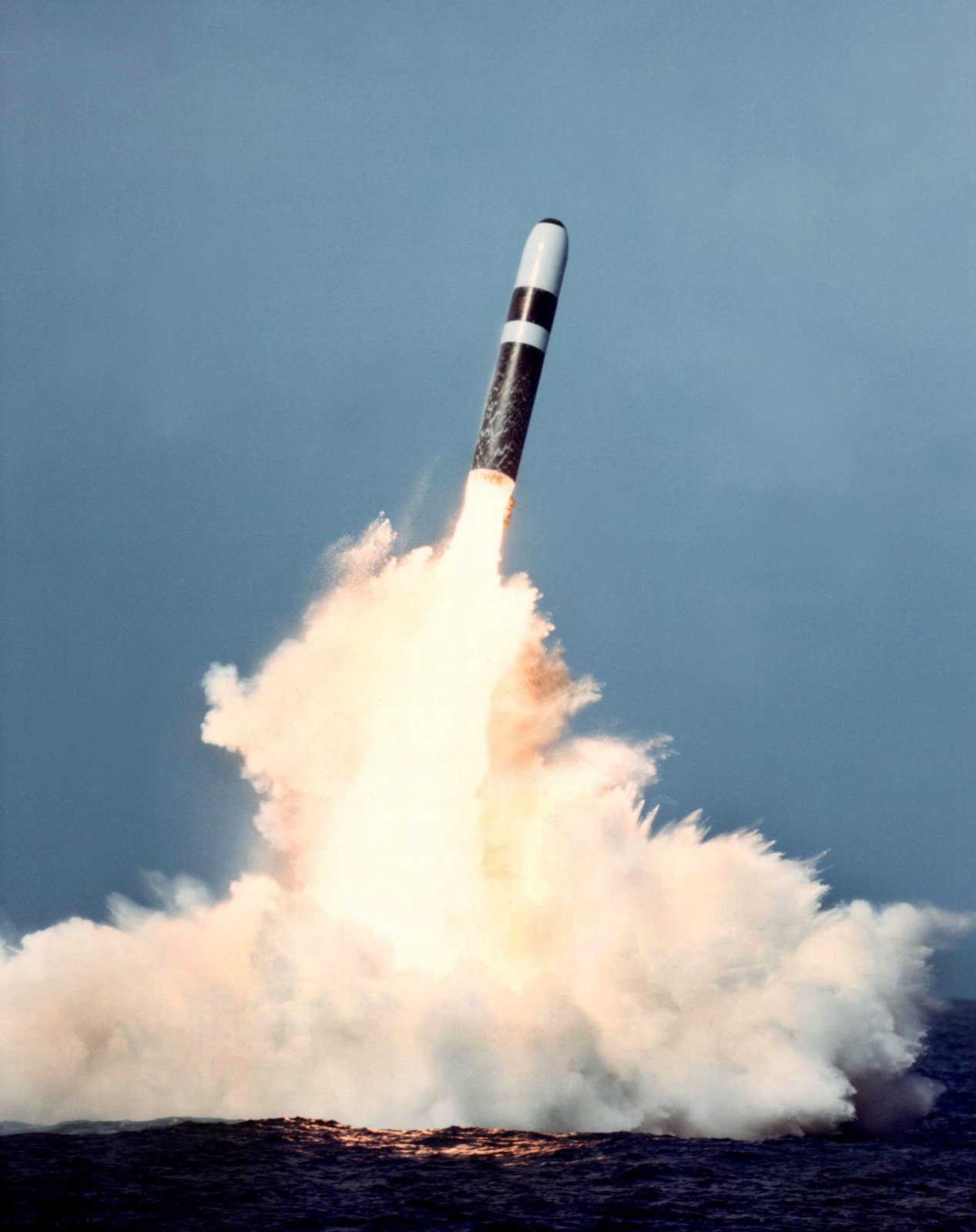
| Trident (Trident II) |
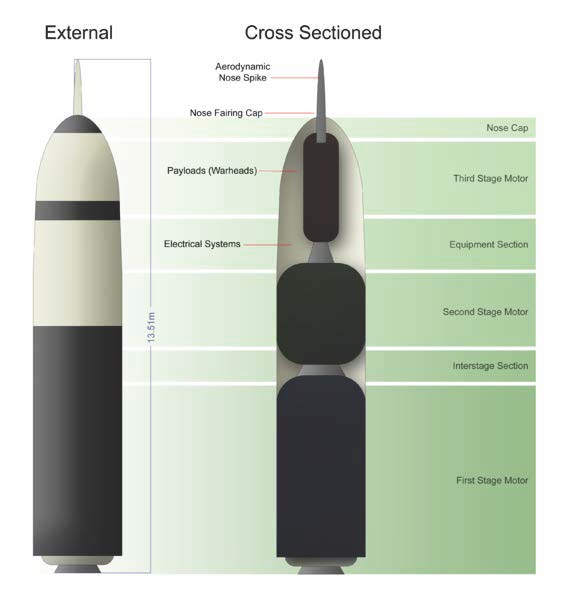
The Trident missile is a submarine-launched ballistic missile (SLBM) designed by Lockheed Martin Space Systems in the United States with multiple independently-targetable reentry vehicle (MIRV) capability. It is armed with nuclear warheads and is launched from nuclear-powered ballistic missile submarines (SSBNs.) The first eight Ohio-class subs were built with the Trident I missiles. Trident were also retrofitted onto 12 SSBNs of the James Madison and Benjamin Franklin classes, replacing Poseidon missiles. The second — and current — variant of the Trident is more sophisticated and can carry a heavier payload. It is accurate enough to be a first strike, counterforce, or second strike weapon. All three stages of the Trident II are made of graphite epoxy, making the missile much lighter. The Trident II was the original missile on Ohio SSBNs from USS Tennessee (SSBN-734) on. The D5 missile is currently carried by fourteen Ohio class SSBNs. Lockheed Martin has carried out 130 consecutive successful test launches of the D5 missile since 1989, according to a company press release.
|
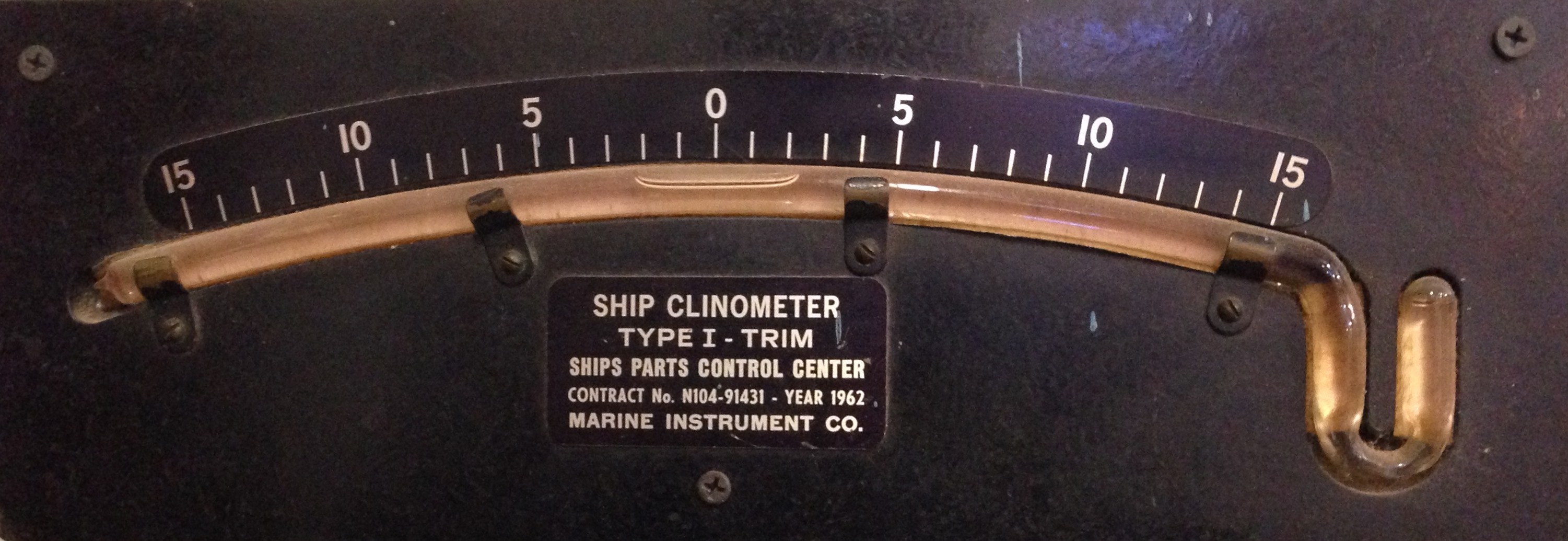
| Trim | A mechanism or system of a submarine which compensates for imbalances fore and aft or port and starboard, so as to maintain level attitude. Can be a noun (for the system or static tendency) or a verb, to use the system to change longitudinal (fore and aft) or lateral (side to side) balance. |
| Uniform | Twenty-first letter of the phonetic (sound) alphabet. Used when voicing the letter "U" to avoid confusion. |
| UQC | The underwater telephone also known as UQC , or Gertrude was developed by the U.S. Navy after World War I, the UQC underwater telephone is used on all manned submersibles in operation. Voices communicated through the UQC are heterodyned to a high pitch for acoustic transmission through water. |
| Variable ballast tanks | Ballast tanks that are not habitually carried completely filled when submerged and whose contents may be varied to provide weight compensation are known as variable ballast tanks. These ballast tanks are constructed to withstand full sea pressure. |
| Vertical Launch Tubes | Vertical tubes, located in the
forward part of the outer hull of 688i-class (final flight of the USS
Los Angeles class) and later submarines that are used to house Tomahawk
and other missiles. These can be fired underwater.
(Vertical launch tube doors are shown open in this 688i-class submarine.) |
| Victor | (1) Twenty-second letter of the phonetic (sound) alphabet.
Used when voicing the letter "V" to avoid confusion. (2) A
class of Soviet nuclear-powered submarine that was originally put into
service by the Soviet Union around 1967. Victor-class subs featured a
teardrop shape, which allowed them to travel at high speed. These
vessels were primarily designed to protect Soviet surface fleets and to
attack American ballistic missile subs, should the need ever arise.
(A Soviet Victor III-class submarine.) |
| Watch |
The standing of duty shifts. The practice varies, but in the US Navy, the watch rotation is as follows:
The purpose of the dogwatches is to permit the watch standers to eat the evening meal. These watches are said to be "dogged." |
| Whiskey | Twenty-third letter of the phonetic (sound) alphabet. Used when voicing the letter "W" to avoid confusion. |
| X-Ray | Twenty-fourth letter of the phonetic (sound) alphabet. Used when voicing the letter "X" to avoid confusion. |
| Yankee | (1) Twenty-fifth letter of the phonetic (sound) alphabet.
Used when voicing the letter "Y" to avoid confusion. (2) The Yankees were the first class of
Soviet subs to have comparable ballistic missile firepower to their
American counterparts. Yankee subs were quieter than their Hotel-class
predecessors (but still louder than NATO submarines) and had smoother
lines that improved their submerged performance. The ships were armed
with 16 ballistic missiles during the Cold War, and served in the Soviet
front lines: in the 1970s up to three Yankees were continually stationed
in a "patrol box" east of Bermuda and off the US Pacific coast.
(Soviet Yankee-class submarine on the surface.) |
| Zulu | (1) Twenty-sixth letter of the phonetic (sound) alphabet.
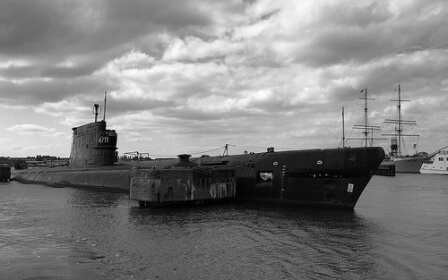
Used when voicing the letter "Z" to avoid confusion. (2) The Soviet Navy's Project 611, also
known by their NATO reporting name of Zulu-class, were designed as
attack submarines, but six were converted in 1956 to become the world's
first ballistic missile submarines, one armed with a single F-11FM Scud
missile and five others with two Scuds each. The missiles were too long
to be contained in the boat's hull, and extended into the enlarged sail.
Soviet submarine B-67 successfully launched a missile on 16 September
1955. The design was influenced by the German Type XXI U-boat of the
World War II era.
|